Colour in nature
Every colour in the natural world is produced by one of a small number of physical or chemical mechanisms — pigments, light-bending structures, scattering, or a material slowly reacting with its environment. This hub connects real photographs to the mechanism behind what’s visible, the nearest named Colourwise colour, and what that means practically.
See methodology for how claims here are scoped and sourced.

Common and rare colours

Common colours in nature
There is no single most common colour in nature — the answer depends on whether area coverage, species count, object count or human visual exposure is being measured, and it varies by habitat, geography and season. Green, brown and blue are the colours most often cited, for different reasons.

Rare colours in nature
Rarity in nature depends heavily on what is being counted. True blue biological pigments are genuinely uncommon; vivid stable purple and bright green pigments outside plants are also comparatively rare. Popular claims that a single colour is 'the rarest in nature' usually collapse several different, more specific facts into one oversimplified statement.

Why is blue rare in nature?
Blue is not rare to see in nature — sky and water both commonly appear blue — but a genuine blue biological pigment is comparatively rare. Most blue-appearing animals, including many blue birds and butterflies, produce the colour structurally: microscopic structures in feathers, scales or skin scatter light so that blue wavelengths dominate, without any blue pigment being present at all.
Colours by domain
Colours in plants
Green dominates most plant foliage because of chlorophyll, the pigment central to photosynthesis, but plants also produce a wide range of other colours through carotenoids, anthocyanins and other pigment families, especially in flowers, fruits and seasonal leaf colour.

Colours in flowers
Flower colour is closely tied to pollinator attraction: different pollinators are drawn to different colours and patterns, and many flowers have evolved pigmentation that stands out against green foliage under the specific vision of their typical pollinators.
Colours in animals
Animal colour comes from a combination of pigments (like melanin and carotenoids) and structural mechanisms, and serves a range of purposes including camouflage, warning display, thermoregulation and mate attraction — though not every colour pattern has a single agreed explanation.

Colours in birds
Bird colour comes from both pigments (mainly melanins and carotenoids) and structural mechanisms, with iridescent shimmer produced by microscopic feather structures that reflect light at different angles rather than by pigment at all.
Colours in insects
Insect colour comes from a mix of pigments and, very commonly, microscopic structural mechanisms — the vivid blues, greens and iridescent shifts seen in many butterflies and beetles are usually produced by the physical structure of their scales or exoskeleton rather than by pigment.
Colours in marine life
Marine colouration ranges from the countershading seen in many open-water fish, to the vivid warning colours of some reef species, to bioluminescence in the deep ocean where sunlight never reaches — with colour serving very different purposes depending on depth and habitat.

Colours in minerals and gemstones
Mineral and gemstone colour is caused by a range of physical and chemical mechanisms — trace element impurities, crystal-structure defects, oxidation state and light-interference effects — meaning that chemically identical minerals can appear in very different colours.

Colours in landscapes
Landscape colour is shaped by climate, vegetation, mineral content and light — deserts tend toward warm tans and ochres, forests toward green and brown, oceans toward blue and teal, and tundra toward muted greys, browns and, seasonally, white.
How natural colour is produced
Pigments in nature
A relatively small number of pigment families — melanins, carotenoids, anthocyanins and chlorophylls chief among them — are responsible for most pigment-based colour across plants, fungi and animals, each with a distinct chemical basis and typical colour range.
Pigment colour vs structural colour
Pigment colour comes from chemical compounds that absorb some wavelengths of light and reflect others; structural colour comes from microscopic physical structures that interfere with light directly, without any pigment involved. Both mechanisms are common in nature, and some organisms combine both in the same colour.
Iridescence and structural colour
Iridescence and structural colour are produced by microscopic physical structures that interfere with light — reflecting different wavelengths depending on viewing angle — rather than by pigment. This is the mechanism behind most blue and shimmering animal colour, including many hummingbirds, butterflies and beetles.
Bioluminescence and fluorescence in nature
Bioluminescence is light generated by a chemical reaction within an organism and is visible in complete darkness; fluorescence is the re-emission of absorbed light at a different (usually longer) wavelength and requires an external light source, typically becoming visible as a glow under UV or blue light.
Function and pattern

Camouflage colours
Camouflage colouration commonly uses muted greens, browns and greys that blend with a specific background, often combined with patterns such as countershading, disruptive colouration or seasonal colour change — the effectiveness of any camouflage colour depends heavily on the specific habitat and the viewer's vision.
Warning colours in nature
Red, yellow and black (or combinations such as black-and-yellow or black-and-red) recur repeatedly as warning colouration across unrelated species because they contrast strongly against natural green and brown backgrounds and are readily learned and remembered by potential predators — this convergence has also enabled widespread mimicry between unrelated warning-coloured species.
Natural colour patterns
A relatively small set of colour patterns — spots, stripes, bands, countershading, eyespots and iridescent shifts among them — recur across many unrelated animal groups, generally because they serve one or more well-documented functions such as camouflage, warning display or signalling, even though the exact purpose is not always established for every individual case.
Seasonal colours in nature
Autumn leaf colour change happens because chlorophyll — the dominant green pigment — breaks down as days shorten, unmasking the yellow and orange carotenoid pigments that were present all along, while red anthocyanin pigments are often newly produced in autumn itself.
How Nature makes colour
A handful of physical and chemical mechanisms account for almost every colour visible in the natural world. These are the same mechanism explanations used throughout the topic pages below, shown together here as an overview.
Biological pigment
A molecule in the tissue absorbs some wavelengths of light and reflects others — the reflected wavelengths are the colour seen. Chlorophyll, carotenoids and melanin are the most common examples.
Common misconception: Not every vivid natural colour is a pigment — several of the most striking blues and greens in animals are structural colour instead, which looks similar but works completely differently.
Structural colour
Microscopic physical structures — ridges, layers or particles smaller than the wavelength of light — interfere with light waves so that only certain wavelengths are reflected back. No pigment is involved at all.
Common misconception: A structurally-coloured feather or scale ground into powder loses its colour completely, because grinding destroys the microscopic structure that produced it.
Scattering
Particles or molecules much smaller than the wavelength of light scatter shorter (blue) wavelengths far more than longer (red) ones — the reason a clear daytime sky looks blue and a low sun looks orange or red.
Seasonal chemical change
A living organism's own chemistry changes with the season — most visibly when a tree stops producing green chlorophyll in autumn, unmasking the yellow, orange and red pigments that were in the leaf all along.
Featured natural palettes
A small, individually rights-verified set of photographs, each with its extracted palette mapped to the nearest Colourwise profile using the same colour-matching engine used throughout the site.
Structural colour

There is no blue pigment anywhere in this wing. Microscopic ridges on each scale split and reflect light so that only blue wavelengths reach the eye — the same physical principle behind a hummingbird's gorget or a peacock's tail.
Whole-frame automated colour extraction on this photograph is dominated by the dark background and shadow between the wings, not the wings themselves — these hexes were hand-picked from the wing surface instead."Blue Morpho" by Derkarts, CC BY-SA 3.0, via Wikimedia CommonsLicence details
- Source:
- Wikimedia Commons
- Creator:
- Derkarts
- Licence:
- CC BY-SA 3.0 (also offered under 2.5/2.0/1.0 and GFDL) — free to share and adapt commercially, provided the work is attributed and any adaptation is shared under a compatible licence.
- Reviewed:
- 2026-07-24
Iridescence

The vivid pink of this gorget isn't pigment at all — microscopic layered structures in the feather interfere with light and reflect only certain wavelengths back, a mechanism called structural colour.
Structural colour is angle-dependent: the same feathers can look black, bronze or magenta depending on the viewing angle and light source, so this photograph shows one specific viewing condition, not a fixed pigment colour."Closeup of Anna's Hummingbird" by Luke Hewitt, CC BY-SA 4.0, via Wikimedia CommonsLicence details
- Source:
- Wikimedia Commons
- Creator:
- Luke Hewitt
- Licence:
- CC BY-SA 4.0 — free to share and adapt commercially, provided the work is attributed and any adaptation is shared under the same licence.
- Reviewed:
- 2026-07-24
Structural colour

Unlike a gemstone coloured by a mineral pigment, opal's flashes of colour come from microscopic silica spheres stacked inside the stone that diffract light — structural colour in a mineral, the same underlying physics as a butterfly wing.
An opal's flashes of colour shift completely with viewing angle and lighting; this photograph captures one specific angle, not the stone's only appearance."Opalescence of the opal" by Masha Milshina, CC BY 4.0, via Wikimedia CommonsLicence details
- Source:
- Wikimedia Commons
- Creator:
- Masha Milshina
- Licence:
- CC BY 4.0 — free to share and adapt commercially, provided the work is attributed.
- Reviewed:
- 2026-07-24
Seasonal chemical change

Green chlorophyll is broken down and reabsorbed by the tree before the leaf falls, unmasking carotenoid and tannin pigments that were in the leaf all along — colours the leaf had all summer, just hidden.
This leaf was scanned flat against a plain background for clarity; the pale scanner background itself was excluded from this palette."Autumn American Sycamore Leaf" by Ninjatacoshell, CC BY-SA 3.0, via Wikimedia CommonsLicence details
- Source:
- Wikimedia Commons
- Creator:
- Ninjatacoshell
- Licence:
- CC BY-SA 3.0 (also offered under GFDL) — free to share and adapt commercially, provided the work is attributed and any adaptation is shared under a compatible licence.
- Reviewed:
- 2026-07-24
Biological pigment

A common misconception is that pink and blue hydrangeas are different varieties. Often they are the same plant: soil acidity changes how much aluminium the roots can absorb, and aluminium uptake is what shifts the pigment from pink to blue.
These are the same species, photographed together specifically because the colour difference is soil chemistry, not genetics or a different cultivar."Hydrangea macrophylla pink and blue" by Gustamons, CC0, via Wikimedia CommonsLicence details
- Source:
- Wikimedia Commons
- Creator:
- Gustamons
- Licence:
- CC0 — dedicated to the public domain by the copyright holder, free for any use.
- Reviewed:
- 2026-07-24
Biological pigment

This gecko's skin doesn't just match a generic 'bark colour' — its blotched pattern and grey-brown tones closely track the specific lichen and bark texture of the trees it lives on.
This is a genuinely difficult photograph to extract colour from by design — the gecko's camouflage means its body and the bark behind it share almost the same palette, which is the point being illustrated."Uroplatus henkeli, Tanafisaka, Sainte-Marie, Analanjirofo region, Madagascar" by Anai171, CC BY 4.0, via Wikimedia CommonsLicence details
- Source:
- Wikimedia Commons
- Creator:
- Anai171
- Licence:
- CC BY 4.0 — free to share and adapt commercially, provided the work is attributed.
- Reviewed:
- 2026-07-24
Oxidation
.jpg)
This isn't just a colour on the copper fixture — the same copper carbonate that turns the metal itself green has washed down and tinted the stone beneath it, a visible record of ongoing oxidation.
The exact shade of verdigris varies with humidity, pollution and how long weathering has continued — this is one specimen at one point in its exposure, not a fixed reference colour."Verdigris" by Alex Liivet, CC0, via Wikimedia CommonsLicence details
- Source:
- Wikimedia Commons
- Creator:
- Alex Liivet
- Licence:
- CC0 — dedicated to the public domain by the copyright holder; verified by Wikimedia's FlickreviewR bot against the original Flickr licence.
- Reviewed:
- 2026-07-24
Scattering

The sky looks blue because air molecules scatter shorter (blue) wavelengths of sunlight far more than longer (red) wavelengths — a phenomenon called Rayleigh scattering. Near the horizon, light passes through more atmosphere and loses more blue, which is why the sky looks paler there.
Sky colour varies continuously with time of day, humidity, pollution and altitude; this is one clear-weather example, not a universal reference blue."Blue Sky" by Shubhamk483, CC BY 4.0, via Wikimedia CommonsLicence details
- Source:
- Wikimedia Commons
- Creator:
- Shubhamk483
- Licence:
- CC BY 4.0 — free to share and adapt commercially, provided the work is attributed.
- Reviewed:
- 2026-07-24
Colours in photographs vary with lighting, material, camera processing and screen calibration — see full licence details on the image credits page.
Featured stories
Why the sky is blue but the horizon looks paler
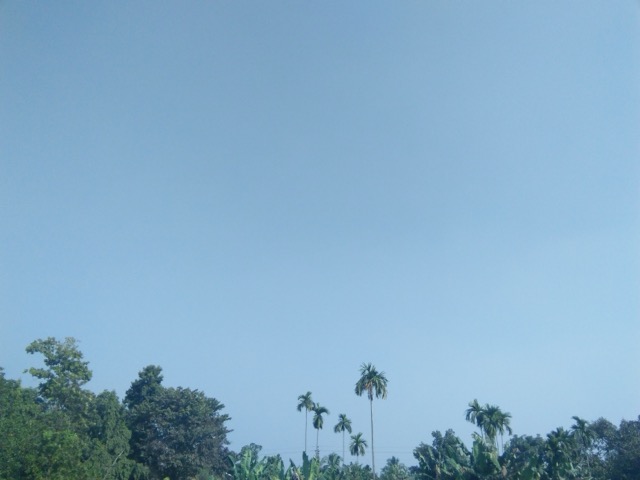
Air molecules scatter short blue wavelengths of sunlight far more than long red wavelengths — a real, well-measured effect called Rayleigh scattering. Straight overhead, light has passed through relatively little atmosphere and looks deep blue; near the horizon, light has travelled through far more air and lost more of that blue to scattering along the way, which is why the sky visibly pales toward the horizon in the same photograph.
In practice: The exact shade of 'sky blue' in a photograph depends heavily on where in the sky it was sampled — near the zenith or near the horizon — not just the time of day.
Why sunsets turn orange and red
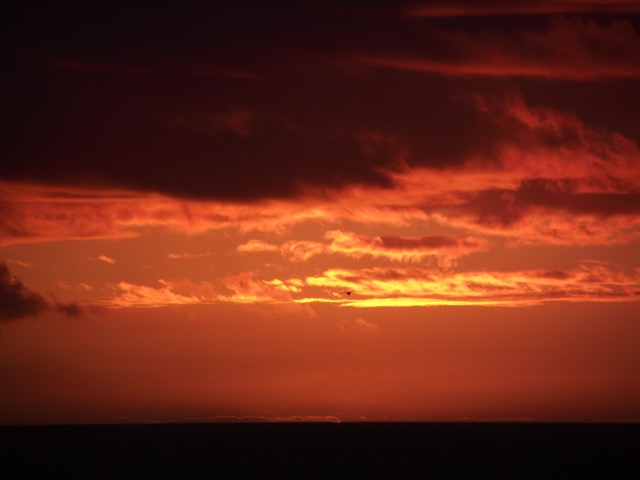
Near sunset, sunlight travels through far more atmosphere to reach an observer than it does at midday. Almost all of the shorter blue wavelengths are scattered away long before the light arrives, leaving the longer orange and red wavelengths dominant — the same Rayleigh scattering responsible for the blue midday sky produces the opposite-looking result at a low sun angle.
In practice: A 'sunset orange' and a 'clear-sky blue' are two visible results of the same physical mechanism, not two unrelated colour phenomena — useful context when a claim implies they need separate explanations.
Why a Blue Morpho looks brown at rest and vivid blue in flight
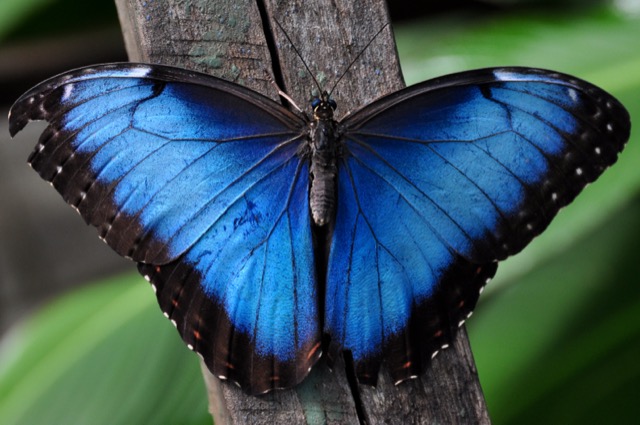
A Blue Morpho's vivid blue only comes from the upper surface of its wings. At rest with wings closed, only the dull brown, eyespot-marked underside is visible — genuine camouflage against leaf litter. In flight, the flash of structural blue is thought to help confuse predators about the butterfly's speed and direction before it lands and effectively disappears again.
In practice: The same animal can be a case study for both camouflage and display colouration depending on which side of the wing is visible — worth checking which side any given photograph actually shows before drawing a conclusion.
Why leaf-tailed geckos don't all look the same shade of grey-brown
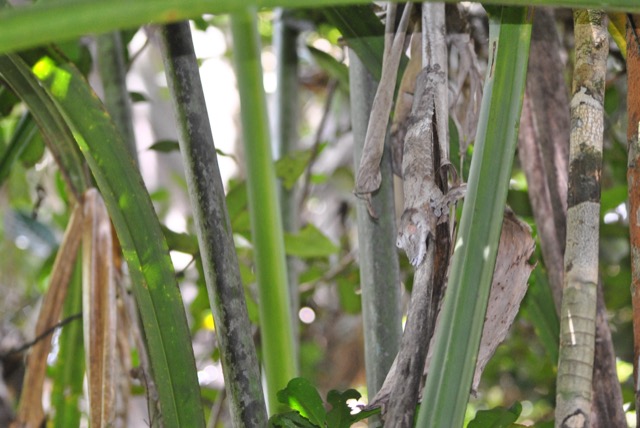
Leaf-tailed gecko camouflage works by closely matching the specific bark and lichen tones of the tree an individual actually lives on, not a single generic 'bark colour'. Individuals from mossier, greener forest tend to show more olive tones; those from drier, paler bark show more grey — the camouflage is a match to the local habitat, not a fixed species colour.
In practice: Describing an entire species as 'grey-brown' understates real, habitat-driven colour variation between individual animals — a caution worth applying to camouflage claims generally.
Nature-inspired practical journeys
Colours drawn from natural photography carry through into practical decisions — a plant’s muted green as a paint colour, a mineral’s deep red as an accent.
Search Nature questions
Try a natural-language question — the same search used across the rest of the site understands questions like these: